
A leading global financial services institution managing over $500B in assets needed to modernize their legacy on-premise infrastructure to reduce operational costs, improve scalability, and accelerate time-to-market for new digital banking products. Their 15-year-old data center infrastructure was becoming increasingly expensive to maintain and couldn't support the agility required for digital transformation.
Financial Services
Enterprise Cloud Migration & Infrastructure Modernization
Primary Outcome
Reduced infrastructure costs by 60% while improving system performance by 3x
60%
Cost Reduction
3x
Performance Gain
99.99%
System Uptime
6 Mo
Implementation
Project Overview
The Challenge
1. Escalating Infrastructure Costs
Operating five global data centers cost $45M annually, with costs increasing 12% year-over-year. Hardware refresh cycles required $8M capital expenditure every 3-4 years. Energy and cooling costs alone exceeded $6M annually.
- $45M annual operational costs with 12% YoY increase
- $8M hardware refresh required every 3-4 years
- Over-provisioned capacity sitting idle 60% of the time
2. Limited Scalability & Agility
Provisioning new infrastructure took 4-6 weeks, preventing rapid response to market opportunities. Peak processing periods (quarter-end, tax season) required permanent over-provisioning. Development teams waited days for test environments.
- 4-6 weeks to provision new infrastructure
- Unable to scale dynamically for seasonal demand
3. Compliance & Security Concerns
Meeting regulatory requirements (SOC 2, PCI DSS, GDPR) across disparate on-premise systems was complex and resource-intensive. Annual compliance audits consumed 3,000+ staff hours. Disaster recovery testing required full production shutdown.
4. Technical Debt & Legacy Systems
200+ applications built on aging infrastructure, many using end-of-life software. Monolithic architecture made updates risky. No containerization or microservices. Limited automation capabilities.
The Solution
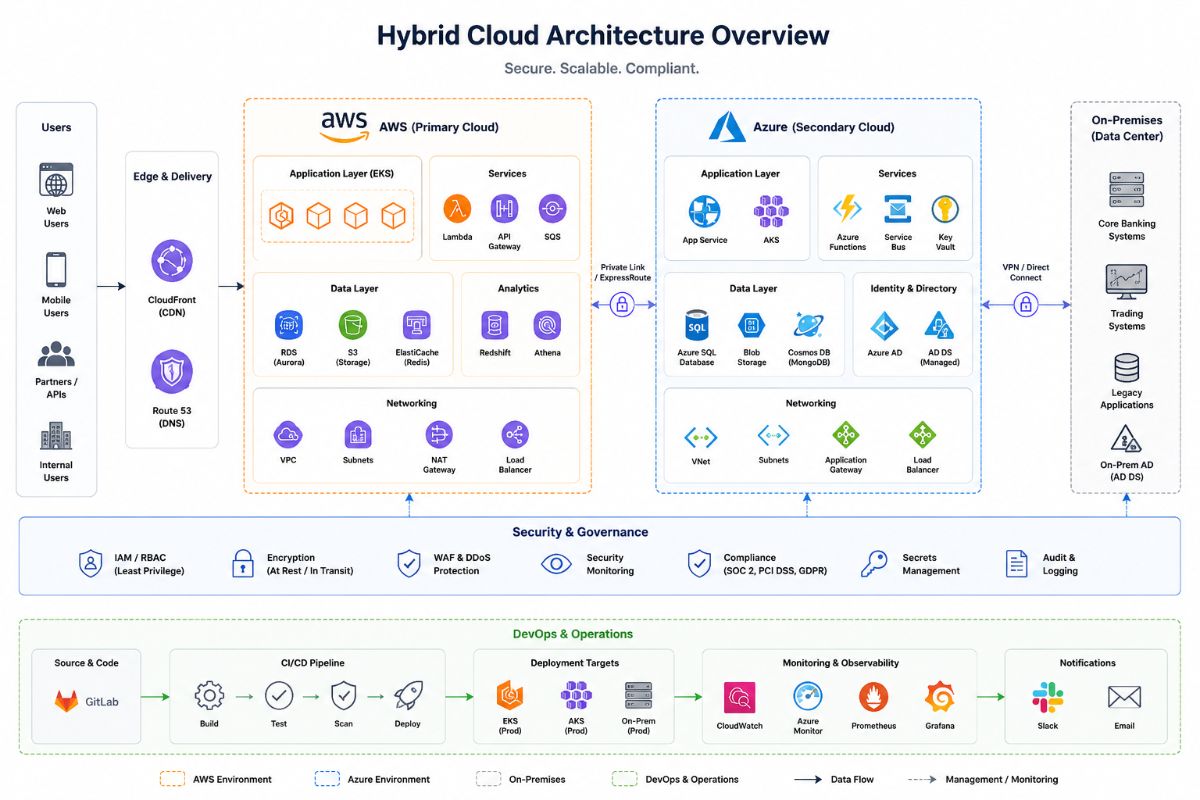
Hybrid Cloud Architecture
We designed and implemented a hybrid cloud architecture leveraging AWS for scalable workloads and Azure for Microsoft-dependent applications, while maintaining on-premise infrastructure for highly regulated trading systems requiring ultra-low latency.
AWS Primary Cloud
Customer-facing applications, data analytics, microservices
Azure Secondary
Microsoft workloads, AD integration, Office 365
Application Modernization
Containerized 150+ applications using Kubernetes, refactored 40 critical applications to microservices architecture, and implemented CI/CD pipelines for automated deployment.
- 150+ applications containerized with Kubernetes
- 40 monoliths refactored to microservices
- Full CI/CD automation with GitLab and Jenkins
Security & Compliance Framework
Implemented comprehensive security controls including encryption at rest and in transit, identity and access management with MFA, automated compliance monitoring, and real-time threat detection.
Results & Outcomes
60%
Infrastructure Cost Reduction
Reduced from $45M to $18M annual infrastructure costs. Eliminated $8M hardware refresh cycles. Pay-as-you-go model reduced over-provisioning waste.
3x
Performance Improvement
Application response times improved from 2.5s to 0.8s average. Database query performance increased 4x. Page load speeds reduced by 65%.
99.99%
System Uptime Achieved
Up from 99.5% on-premise. Zero unplanned downtime in first 12 months. Automated failover reduces MTTR from 4 hours to 8 minutes.
95%
Faster Deployment Cycles
Infrastructure provisioning from 4-6 weeks to 15 minutes. Development teams deploy 10x more frequently. Test environments on-demand in minutes.
85%
Reduced Compliance Effort
Annual audit preparation from 3,000 to 450 staff hours. Automated compliance monitoring and reporting. Continuous security posture validation.
40%
Carbon Footprint Reduction
Cloud provider's renewable energy reduced carbon emissions by 40%. Eliminated 5 data centers and their environmental impact.
Technologies Used
Cloud Platforms
AWS
Azure
CloudFront CDN
Route 53
Containers & Orchestration
Kubernetes
Docker
EKS
Helm
Infrastructure as Code
Terraform
CloudFormation
Ansible
Business Impact
$27M Annual Cost Savings
Infrastructure costs reduced from $45M to $18M annually. ROI achieved in 8 months. Eliminated capital expenditure for hardware refresh cycles. Operational efficiency gains freed up 25 IT staff for strategic initiatives.
Accelerated Time-to-Market
New digital banking features deployed 10x faster, enabling rapid response to competitive threats. Launched mobile banking redesign in 6 weeks vs. previous 9-month timeline. Increased feature release frequency from quarterly to weekly.
Enhanced Customer Experience
65% faster application performance improved customer satisfaction scores from 3.2 to 4.6 out of 5. Mobile app session times increased 45%. Customer complaint volume related to system performance reduced 80%.